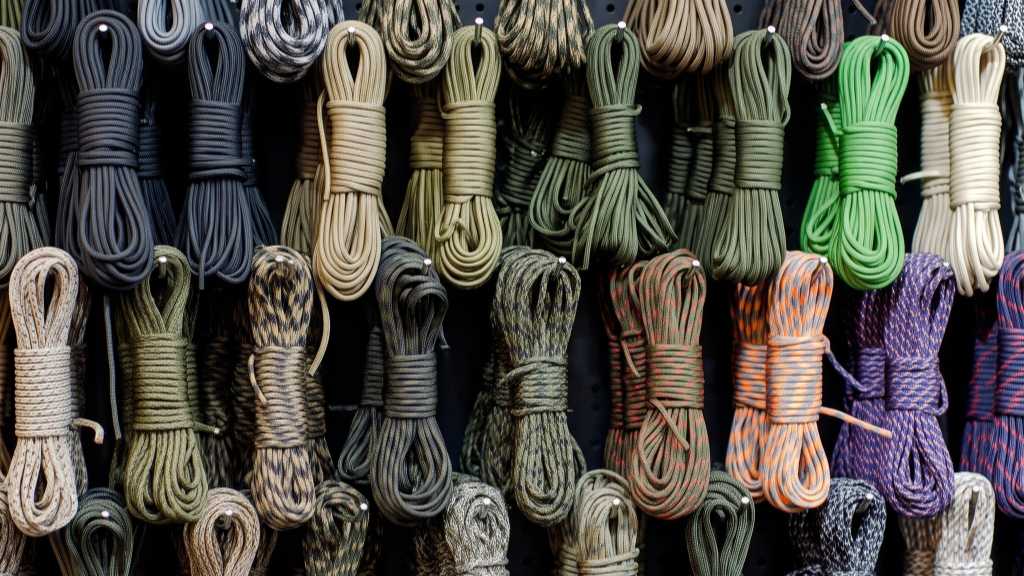
If you talk to any survival instructor, wilderness guide, or seasoned backcountry hiker, they will all list "550 Paracord" as one of the ten essential items in their pack.
It’s often considered the ultimate wilderness multi-tool. You can use it to build emergency shelters, replace broken shoelaces, create fishing lines from the inner strands, or lash gear to your boat for a float.
But there’s a massive misconception in the outdoor community. Just because it is braided nylon and looks like paracord doesn't mean it’s the rugged, life-saving equipment that it is supposed to be. In fact, if you bought your paracord at a discount craft store or from a generic listing on Amazon, your "survival cord" might be completely useless when you need it most.
Let’s cut through the noise and figure out what makes some paracord premium, and what makes some total crap.
What Exactly Is 550 Paracord?
The term "paracord" comes from "parachute cord." It was originally developed by the U.S. military during World War II for suspension lines on parachutes. It is a lightweight, all-nylon kernmantle rope—meaning it has an inner core (kern) protected by a woven outer sheath (mantle).
The most common variant used in the outdoor world is Type III Paracord, also known as 550 Cord.
The "550" is the critical specification: it has a static tensile (breaking) strength of 550 pounds (249 kg).
That’s why true paracord is so versatile. You have a super-strong cord, and in an emergency, you can gut the inner core to create 7 smaller (approx. 35lb test) inner lines.
The Crucial Differences: Military-Spec (Mil-Spec) vs. Commercial Cord
This is where beginners get scammed. All paracord is either Mil-Spec (Military Specification) or Commercial grade. One is life-saving equipment; the other is for making bracelets.
1. Mil-Spec (MIL-C-5040H) | The Gold Standard
To be labeled true Mil-Spec, the cord must meet the rigid specifications set by the U.S. government for military use.
- The Inner Core: It MUST contain 7 or 9 inner core strands, and each of those strands MUST be composed of 3 smaller plies (yarns) twisted together.
- The Sheath: The outer sheath must be 100% high-quality nylon and cannot be made of filler materials like polyester.
- The Trace Strand: Look for a colored marker (often yellow or red) twisted into one of the 7 core strands. This is the official "trace strand" that proves it met the government standard.
When you buy Mil-Spec cord, you know exactly what you are getting.
2. Commercial-Grade Cord | The Craft Cord
This is what 90% of civilian retailers sell. While it might look the same and is often labeled "Type III" or "550," it does not adhere to military specifications.
- The Inner Core: Commercial cord usually only contains 7 strands, and those strands are almost always made of only 2 plies twisted together. This immediately reduces the strength and durability.
- The Filler Issue: Bad commercial cord often uses lower-quality nylon—or worse, a nylon sheath over a cheap polyester core. Polyester is nowhere near as strong, elastic, or abrasion-resistant as nylon. It fails quickly under stress.
The Bushgear Verdict: Commercial cord is fine for tying down a tarp at a drive-in campsite or making a keychain. It is not for emergency rappelling, securing heavy loads on a boat, or shelter building in the Canadian wilderness.
The Final Showdown: Cheap vs. Expensive Brands (Is it worth it?)
You are right to ask: Are expensive brands just selling the same cord in prettier packaging?
In the paracord world, no, they are not the same. With cheap, generic paracord, you have zero guarantees about construction, materials, or quality control. You might get 2-ply cores, or you might get a mixture of nylon and garbage filler.
Premium, dedicated paracord brands charge more because they maintain strict control over the manufacturing process, ensuring the 550lb breaking strength is a guaranteed fact, not a marketing claim. They test for knot hold, abrasion resistance, and consistent thickness.
When you invest in a quality cord, you are paying for reliability. In the bush, consistency is king.
Bushgear Recommended Paracord Brands
Don't trust your safety to craft supplies. We recommend these brands, which are known for producing consistent, high-quality Type III Mil-Spec cord:
- Atwood Rope MFG: The industry standard. Known for making perhaps the widest range of high-quality, genuine Mil-Spec cordage on the planet.
- Tough-Grid: Another premium, US-made brand that guarantees genuine Mil-Spec Type III construction and materials.
- Readywise / Paracord Planet (Verified Listings): Check the listings for explicit mentions of "7-strand, 3-ply nylon core." They often offer verified Mil-Spec options.